The year is 2026, and the traditional waiting room is starting to look like a museum exhibit. You know the one: stale coffee, a stack of Highlights magazines from 2019, and that specific fluorescent hum that screams "clinical efficiency" while actually being anything but.
For healthcare leaders and visionary leaders reading this, the message is clear: If your growth strategy is still tied to the physical square footage of your office, you aren’t just behind the curve: you’re standing on a different track entirely. The "Non-Clinic" Clinic is no longer a futuristic theory; it is the national standard for 2026.
At HealthPath Solutions, we aren't just watching this shift; we’re architecting the billing and operational frameworks that make it profitable. Let’s dive into why the living room is your new primary care suite and how you can manage the complexity without losing your clinical soul.
The Death of the "Four-Walls" Strategy
In 2025, many practices were still patting themselves on the back for having a "Telehealth option." They treated virtual visits like a backup plan: a digital spare tire for when the patient couldn't make the drive.
Fast forward to mid-2026, and the "Non-Clinic" model has flipped the script. We are seeing a decentralization of care that moves beyond the screen. We’re talking about integrated home diagnostics, ambient biometric monitoring, and a patient experience that feels less like a "transaction" and more like a continuous, data-driven partnership.
From a Strategic Purview, your market positioning depends on this. The "Sovereign Professional": the physician who wants autonomy and better outcomes: is moving toward models that don't require $40/sq. ft. overhead just to check a blood pressure. By decentralizing, you aren't just saving on rent; you’re expanding your catchment area from a 10-mile radius to a national footprint.
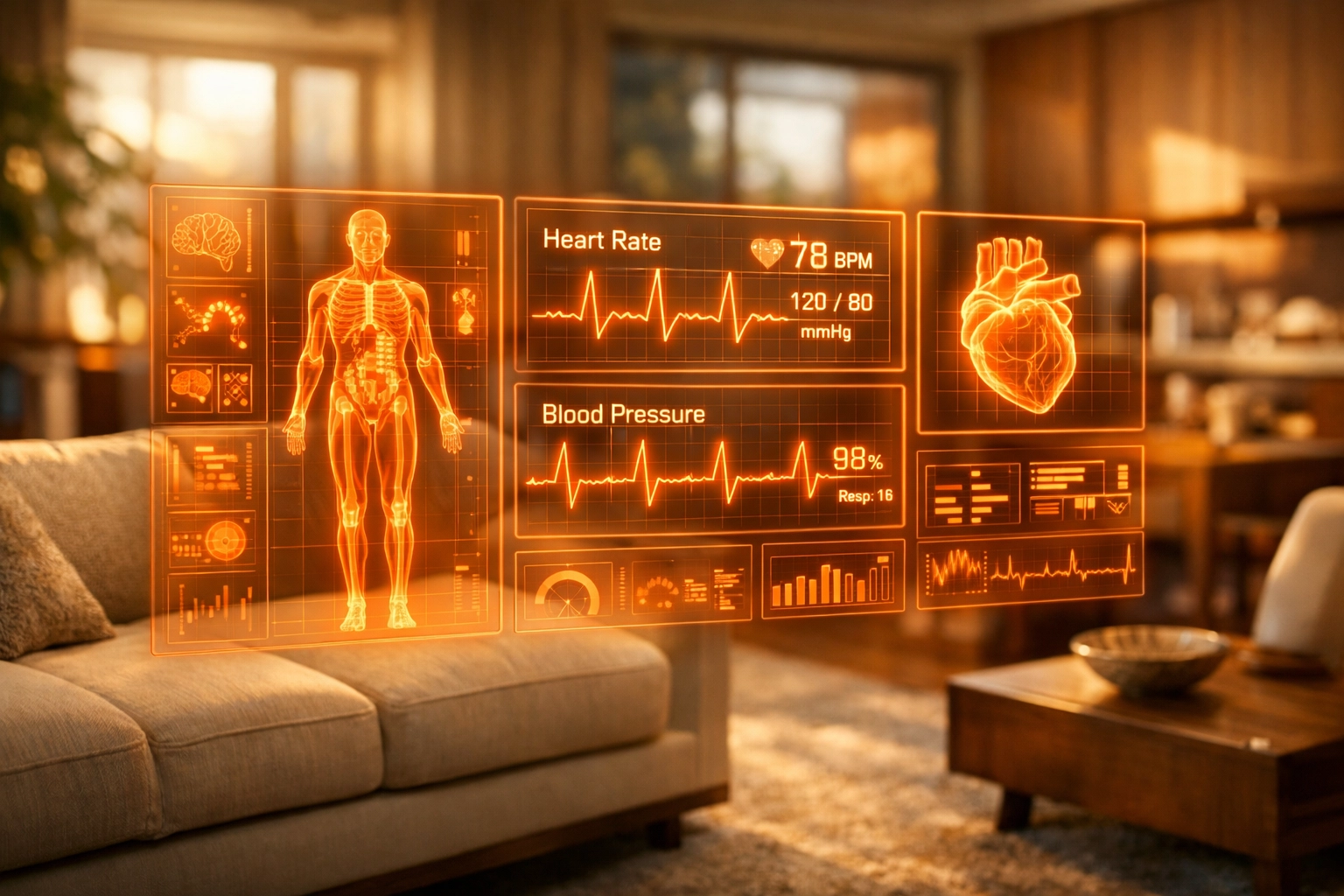
Visual Idea: A futuristic medical "blueprint" superimposed over a cozy, high-end living room, illustrating the merge of comfort and high-tech care.
Operations: The Architecture of Remote ROI
Let’s get real. Moving care to the living room sounds great until you look at the billing department. How do you capture the value of a patient’s wearable data? How do you ensure the remote diagnostics are coded correctly when there’s no "front desk" to check them in?
This is where the Operational Purview becomes the make-or-break factor. In 2025, the challenge was "How do we get paid for a Zoom call?" In 2026, the question is "How do we monetize the 24/7 stream of clinical data coming from our patients?"
The architecture of the future practice requires:
- Agentic AI Integration: Not just "EHR-lite," but AI agents that pre-code encounters based on ambient audio and biometric triggers before the clinician even signs the note.
- Remote Data Architecture: A system that treats a home-based diagnostic test with the same billing rigor as an in-house lab.
- Proactive Revenue Cycles: Instead of waiting for a claim to be denied, the "Non-Clinic" clinic uses predictive modeling to ensure compliance across national insurance carriers.
If your practice management isn't built to handle these "non-traditional" streams, you’re leaving 30% of your potential revenue on the table. You can explore our service-sitemap.xml to see how we’re restructuring these exact operational flows.
Clinical Purview: The Patient as a Proactive Node
Clinical outcomes are fundamentally better when the patient is in their natural habitat. White-coat hypertension is real, but "Living Room Compliance" is even more impactful.
In the 2026 model, the "Non-Clinic" allows for Continuous Clinical Reasoning. Instead of a snapshot every six months, healthcare leaders now have a dashboard of real-time health data. This isn't just about "telehealth"; it's about shifting the clinical mindset from reactive (waiting for the patient to get sick) to architectural (building a lifestyle that prevents it).
For leaders across clinical, operational, and strategic roles, this means your teams can spend less time on the "mechanics" of a visit: the height, weight, and temp: and more time on high-level decision-making. The technology does the "janitorial" work of data collection, leaving visionary leaders to be the true "Architects of Longevity."

Visual Idea: A sleek, holographic dashboard showing a map of the United States with glowing "health nodes" representing patients in their homes.
2025 vs. 2026: The Great Decentralization
| Feature | 2025 (The "Coping" Era) | 2026 (The "Mastery" Era) |
|---|---|---|
| Telehealth | Occasional video calls. | Standard of care with ambient AI. |
| Data Flow | Manual entry into EHR. | Automated biometric streams with pre-coding. |
| Billing | Fixed fee-for-service. | Value-based architecture + Remote Monitoring. |
| Patient Experience | Waiting rooms and paperwork. | Decentralized, mobile-first, and friction-free. |
| Leadership Focus | Reducing overhead. | Expanding national clinical influence. |
In 2025, we were still figuring out how to make the technology "work." In 2026, the technology is the work. The shift from a regional provider to a national authority happens the moment you realize your clinic isn't a building; it's a network.
Beyond the Ledger: Why You Need an Architect, Not a Janitor
Most practice management companies act like janitors. They show up after the mess is made and try to clean up your billing. At HealthPath Solutions, we’re the architects. We help you design the "Non-Clinic" model so that the mess never happens in the first place.
Whether you are looking for advanced Medical Billing strategies or looking to restructure your entire Team, we provide the vision to move beyond the traditional ledger.
We aren't just talking about changing your software; we’re talking about changing your business DNA. The leaders who win in 2026 are those who embrace the "Living Room" clinic as a competitive advantage, not a logistical burden.

Visual Idea: An abstract representation of data and comfort: think stylized fiber-optic cables woven into a soft, designer rug.
The Takeaway: Stop Building Walls, Start Building Networks
The "Non-Clinic" clinic is about freedom.
- Freedom for healthcare leaders to scale without real estate constraints.
- Freedom for clinical and operational leaders to use real-time data instead of six-month-old snapshots.
- Freedom for the Patient to receive world-class care on their own couch.
As a national leader, your job is to identify these shifts before they become common knowledge. Don’t wait for the industry to tell you what the "standard of care" is: set the standard yourself.
Are you ready to move your practice into the future? We’re here to help you draw the blueprints.
Ready to architect your future?
Book a discovery call with HealthPath Solutions today.
Learn more about our visionary approach to practice management at HealthPath Solutions.
Have a healthy path forward, HealthPath Solutions.





References:
- Healthcare IT News (2026): "The Rise of Ambient AI in the Ambulatory Setting."
- Journal of Medical Practice Management: "Decentralized Care: Economics of the Non-Clinic Model."
- MGMA Trends Report: "Practice Management in 2026: Beyond the Physical Office."
- HHS.gov: "Updated Guidelines for Remote Patient Monitoring and Data Reimbursement (2026)."